The First Smiley Face
As told by the elders of the Flintshade Tribe, somewhere in the Year of the Mammoth, long before the counting of kings.
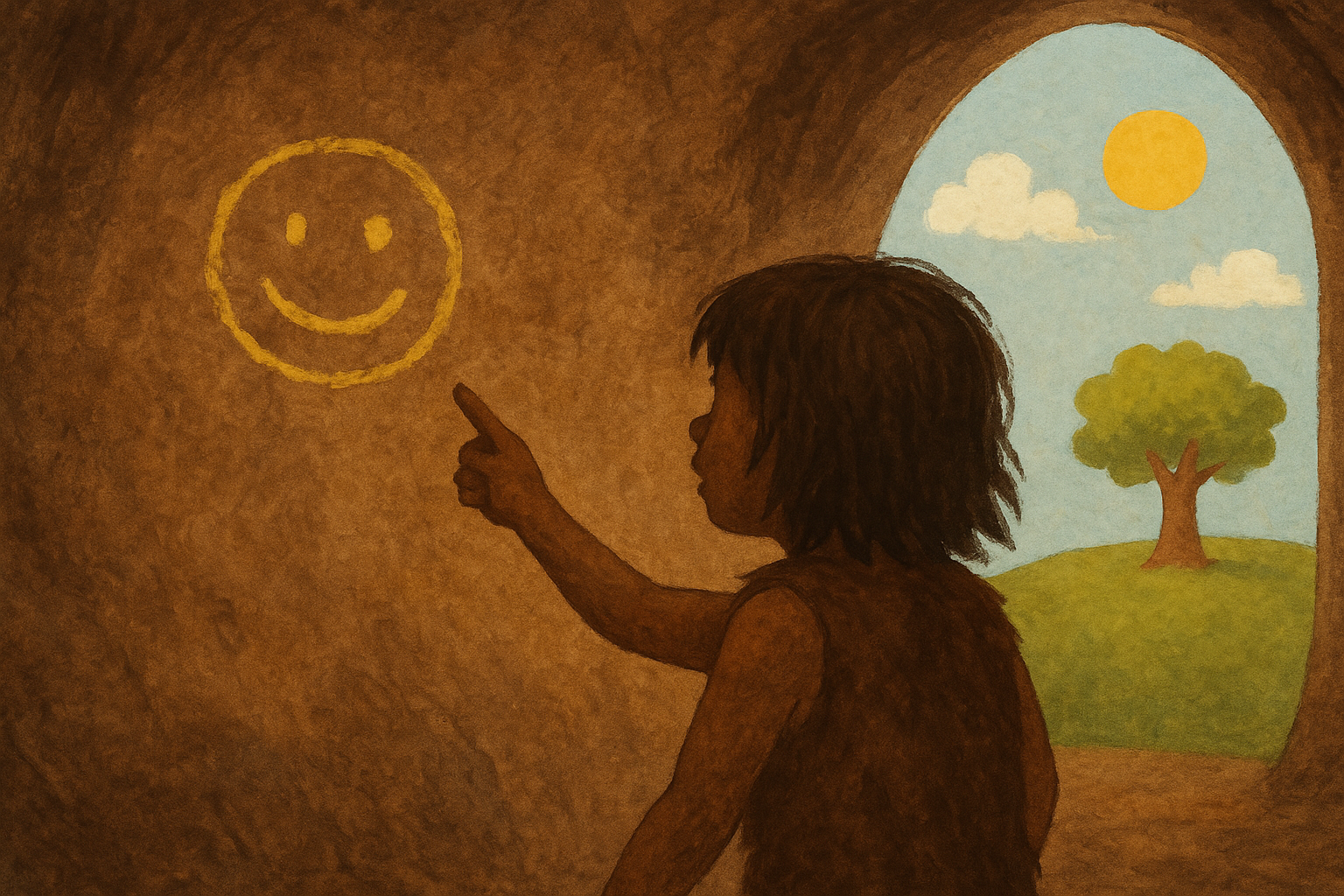
Long ago, in the shadowy belly of the world, where caves cradled fire and the winds still carried the breath of the gods, there lived a curious child named Tikku. Tikku was not like the other children of the Flintshade Tribe. While others hunted beetles and wrestled in the mud, Tikku stared at shadows, traced patterns in the air, and asked far too many questions for comfort.
Now, the Flintshade were proud people, with sacred rules and stern ways. Chief Morn, who wore the teeth of saber-cats and never blinked, declared that the walls of the family cave were holy—meant only for the marks of hunters and shaman-dreams. No child’s hand was to sully them.
But Tikku… oh, Tikku.
One rainy moon, when the cave mouth dripped like a weeping sky, Tikku picked up a bit of ochre chalk and crept to the far side of the wall. There, behind the sleeping skins and dried fish, Tikku made a circle. Two dots. And a curving line below.
It was a face, yes—but not one of fear or rage, nor of the beast spirits. It was something else.
A face of joy.
A smile.
He did not know why he made it. Only that he must.
In the morning, the tribe discovered the mark. Gasps echoed. Some cried out that a spirit-child had offended the cave gods. Chief Morn was furious. Tikku was dragged before the fire and made to confess.
"I saw it in the cloud, Chief," Tikku whispered, trembling. "The shape the sky made. It looked happy. I wanted to remember it."
The tribe prepared to punish Tikku—perhaps banishment to the Wind Cracks. But just then, Old Mother Rue, the blind dream-weaver, shuffled forward.
"Let the boy speak no more," she said. "Let the mark speak for him."
And so, they looked again. The hunters saw no prey. The shaman saw no omen. But the children—they laughed. A soft, golden laugh like honey on bark. For the face, though simple, made them feel… warm. As though the sun had peeked into the cave itself.
From that day on, the First Smiley was not scrubbed away. Instead, it became a charm—drawn on spears before hunts, painted on mothers' bellies before birth. They said it kept the spirits light and the shadows gentle.
Tikku, once the troublemaker, became Tikku the Joy-Bringer.
And though the centuries would bury the cave, drown the tribe in forgetfulness, and scatter their bones into dust—the smile would live on.
Not carved in stone, perhaps… but etched into the hearts of all who still find joy in the simplest of symbols.
“The First Smiley Face” was written by Dr. Elias Hartwell - Time traveler safeguarding history and folklore. and Steven M. Tilley.